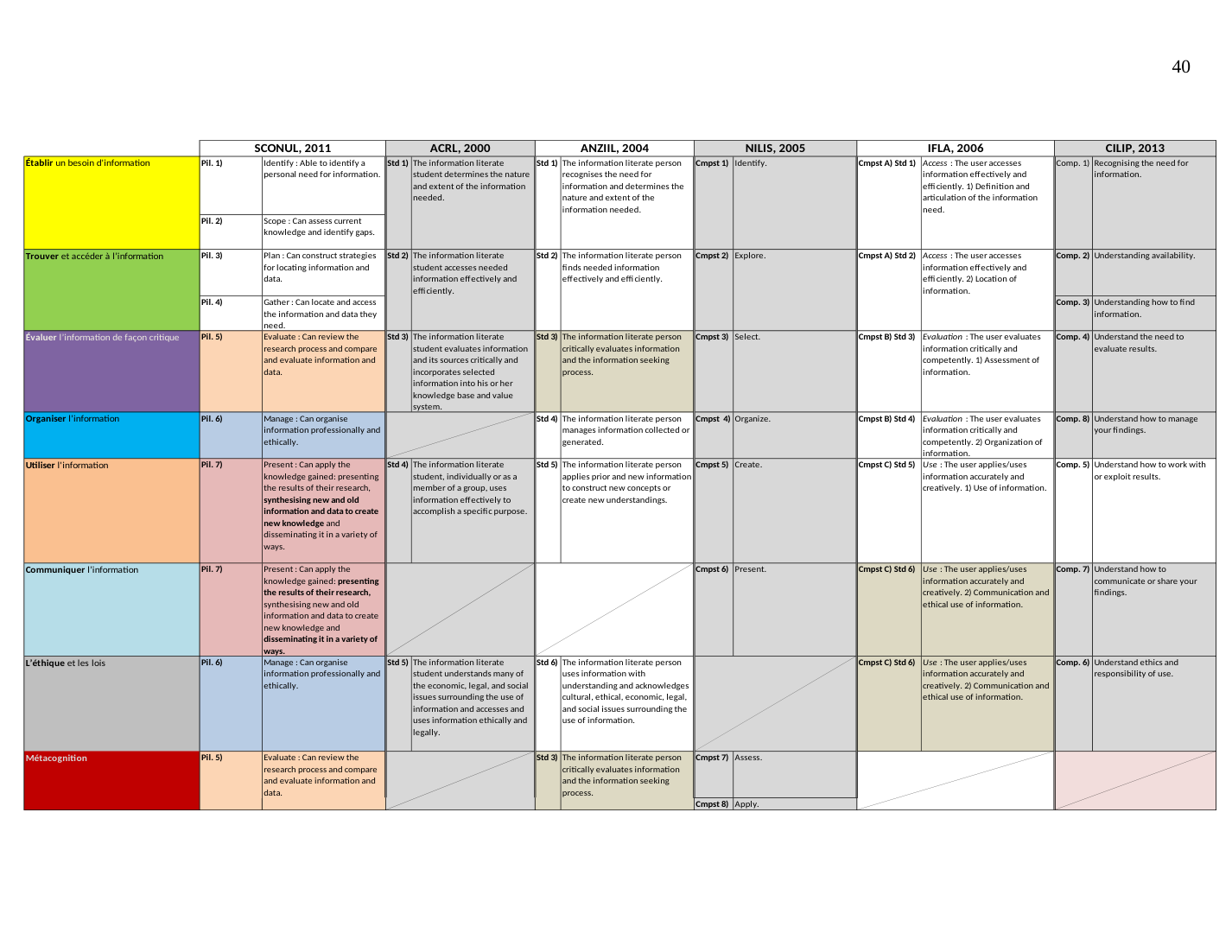
Modèle historique d’infolittératie. Les extraits français des manuscrits et les indicateurs anglais sont reproduits dans leur langue d’origine. Les traductions anglaises des extraits français sont éditoriales et datées de 2026. Les renvois Pxxx désignent les paragraphes directs de word/document.xml, paragraphes vides inclus; ils ne sont pas des numéros de page.
Les sept images vectorielles des annexes sont identiques octet pour octet dans les deux copies examinées. Les captures ci-dessous sont rendues depuis la copie 4.0, sans modifier les tableaux.
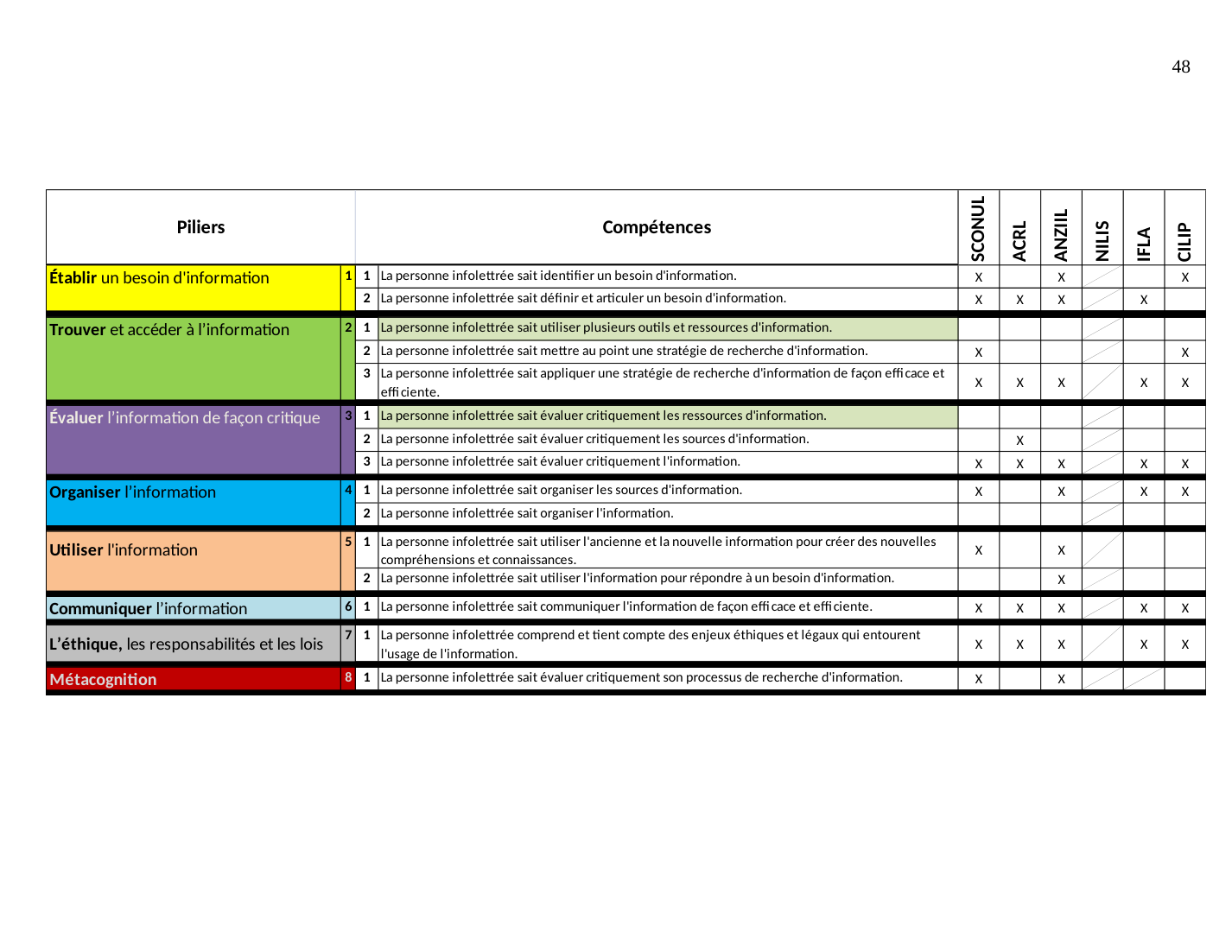
Incohérence de numérotation conservée.Dans le corps des deux manuscrits : métacognition 7, éthique et lois 8. Dans l’annexe 3 : éthique, responsabilités et lois 7, métacognition 8. Cette divergence est conservée sans interprétation de son intention. Le champ hachuré de NILIS et les cases vides restent des marques documentaires, pas des conclusions sur l’absence de contribution.
Annexe 3 · 15 compétences et correspondances
Ordre et numéros de l’annexe. Une marque X signifie seulement « X présent dans le tableau ». La colonne NILIS est hachurée dans l’image. Les cases vides ne sont pas complétées.
Code de l’annexe
Texte français d’origine
Traduction éditoriale anglaise
SCONUL
ACRL
ANZIIL
NILIS
IFLA
CILIP
1.1
La personne infolettrée sait identifier un besoin d'information.
The information-literate person knows how to identify an information need.
X
—
X
▨
—
X
1.2
La personne infolettrée sait définir et articuler un besoin d'information.
The information-literate person knows how to define and articulate an information need.
X
X
X
▨
X
—
2.1
La personne infolettrée sait utiliser plusieurs outils et ressources d'information.
The information-literate person knows how to use several information tools and resources.
—
—
—
▨
—
—
2.2
La personne infolettrée sait mettre au point une stratégie de recherche d'information.
The information-literate person knows how to develop an information-search strategy.
X
—
—
▨
—
X
2.3
La personne infolettrée sait appliquer une stratégie de recherche d'information de façon efficace et efficiente.
The information-literate person knows how to apply an information-search strategy effectively and efficiently.
X
X
X
▨
X
X
3.1
La personne infolettrée sait évaluer critiquement les ressources d'information.
The information-literate person knows how to critically evaluate information resources.
—
—
—
▨
—
—
3.2
La personne infolettrée sait évaluer critiquement les sources d'information.
The information-literate person knows how to critically evaluate information sources.
—
X
—
▨
—
—
3.3
La personne infolettrée sait évaluer critiquement l'information.
The information-literate person knows how to critically evaluate information.
X
X
X
▨
X
X
4.1
La personne infolettrée sait organiser les sources d'information.
The information-literate person knows how to organize information sources.
X
—
X
▨
X
X
4.2
La personne infolettrée sait organiser l'information.
The information-literate person knows how to organize information.
—
—
—
▨
—
—
5.1
La personne infolettrée sait utiliser l'ancienne et la nouvelle information pour créer des nouvelles compréhensions et connaissances.
The information-literate person knows how to use old and new information to create new understandings and knowledge.
X
—
X
▨
—
—
5.2
La personne infolettrée sait utiliser l'information pour répondre à un besoin d'information.
The information-literate person knows how to use information to meet an information need.
—
—
X
▨
—
—
6.1
La personne infolettrée sait communiquer l'information de façon efficace et efficiente.
The information-literate person knows how to communicate information effectively and efficiently.
X
X
X
▨
X
X
7.1
La personne infolettrée comprend et tient compte des enjeux éthiques et légaux qui entourent l'usage de l'information.
The information-literate person understands and takes into account the ethical and legal issues surrounding the use of information.
X
X
X
▨
X
X
8.1
La personne infolettrée sait évaluer critiquement son processus de recherche d'information.
The information-literate person knows how to critically evaluate their information-research process.
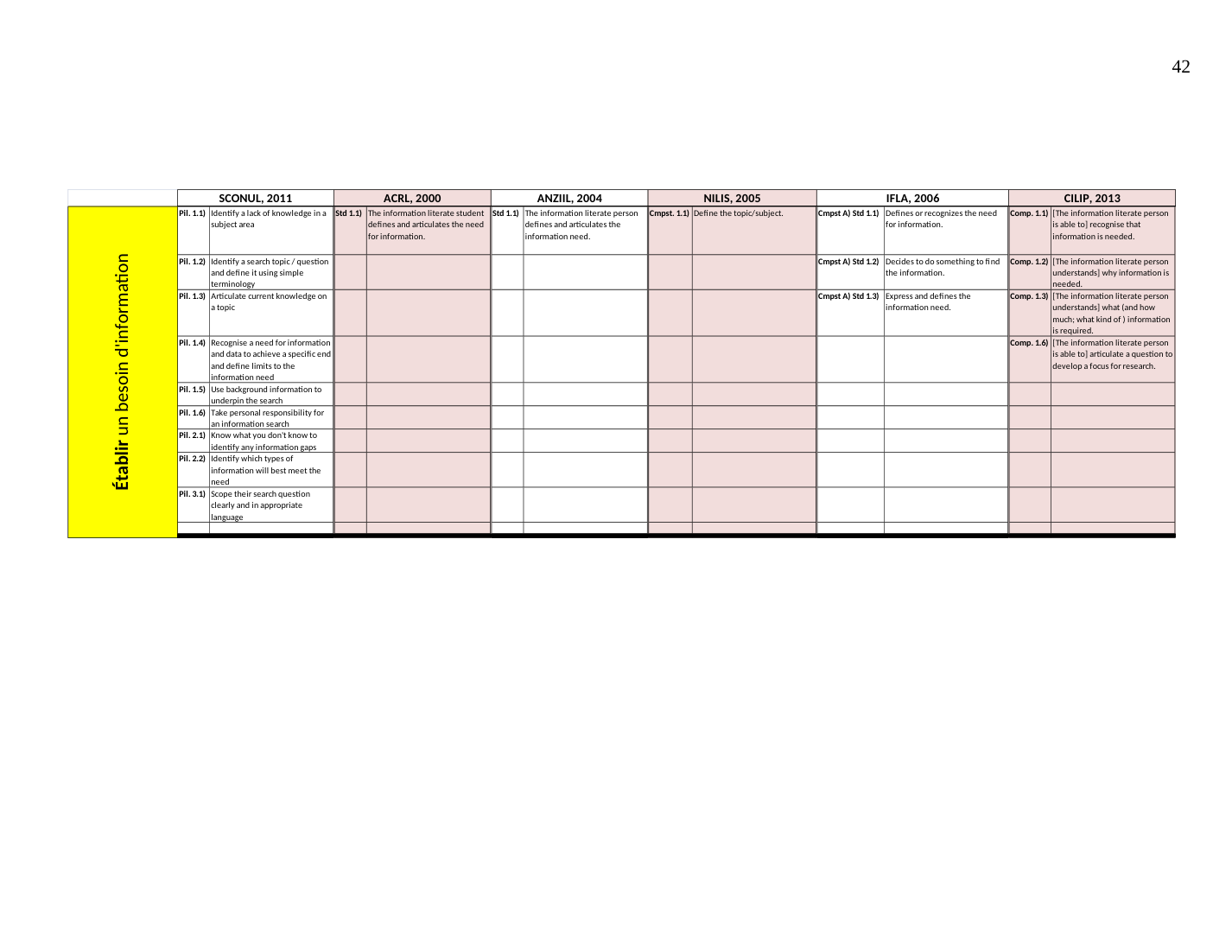
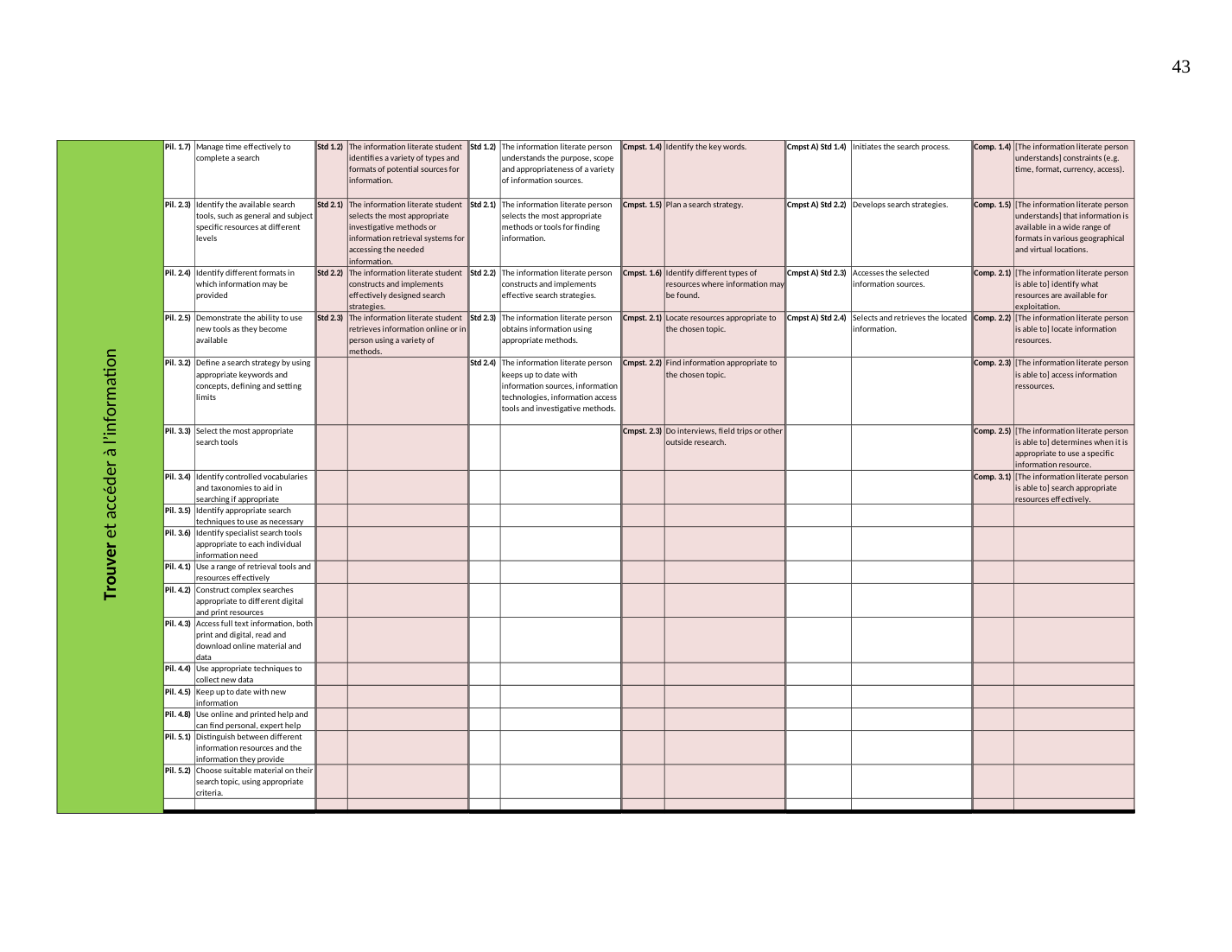
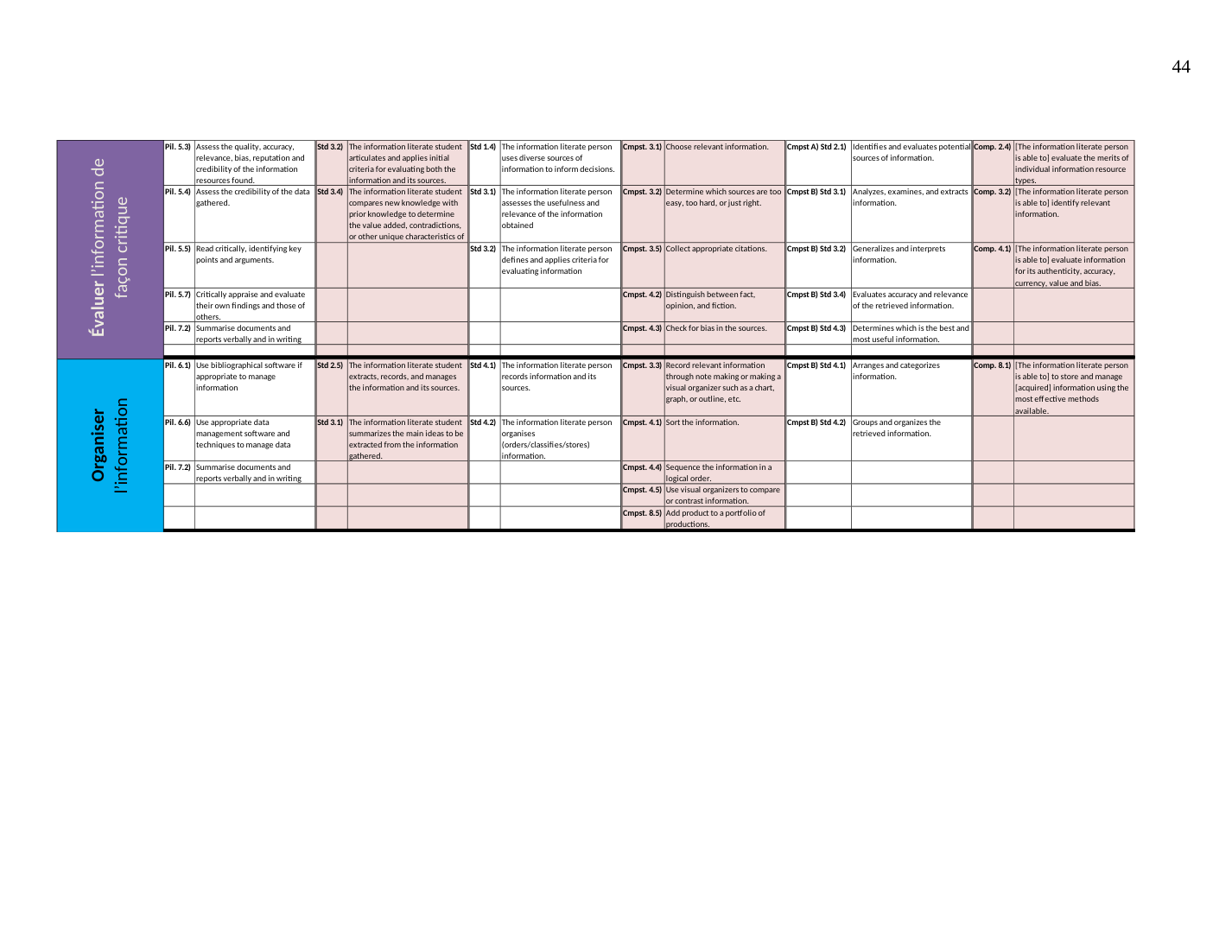
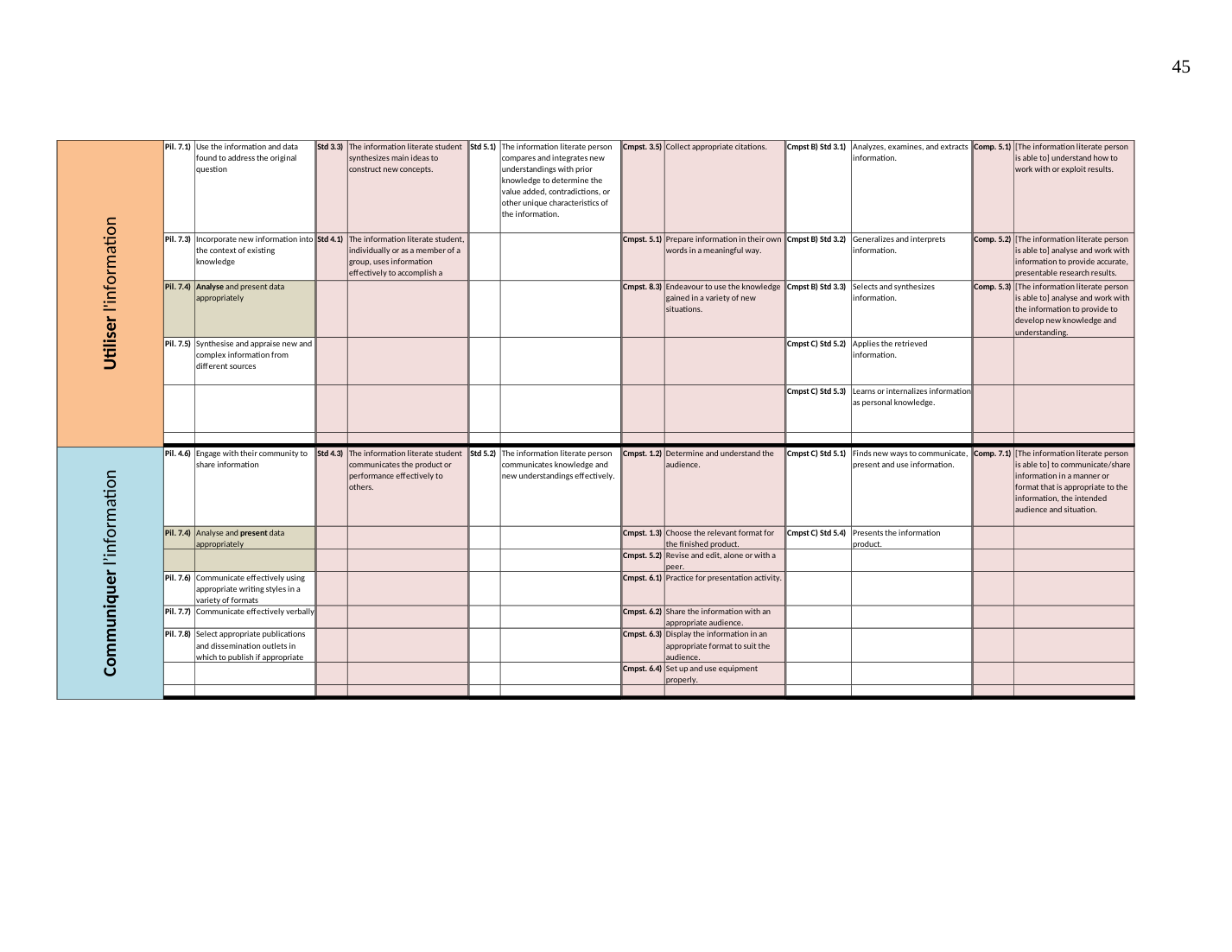
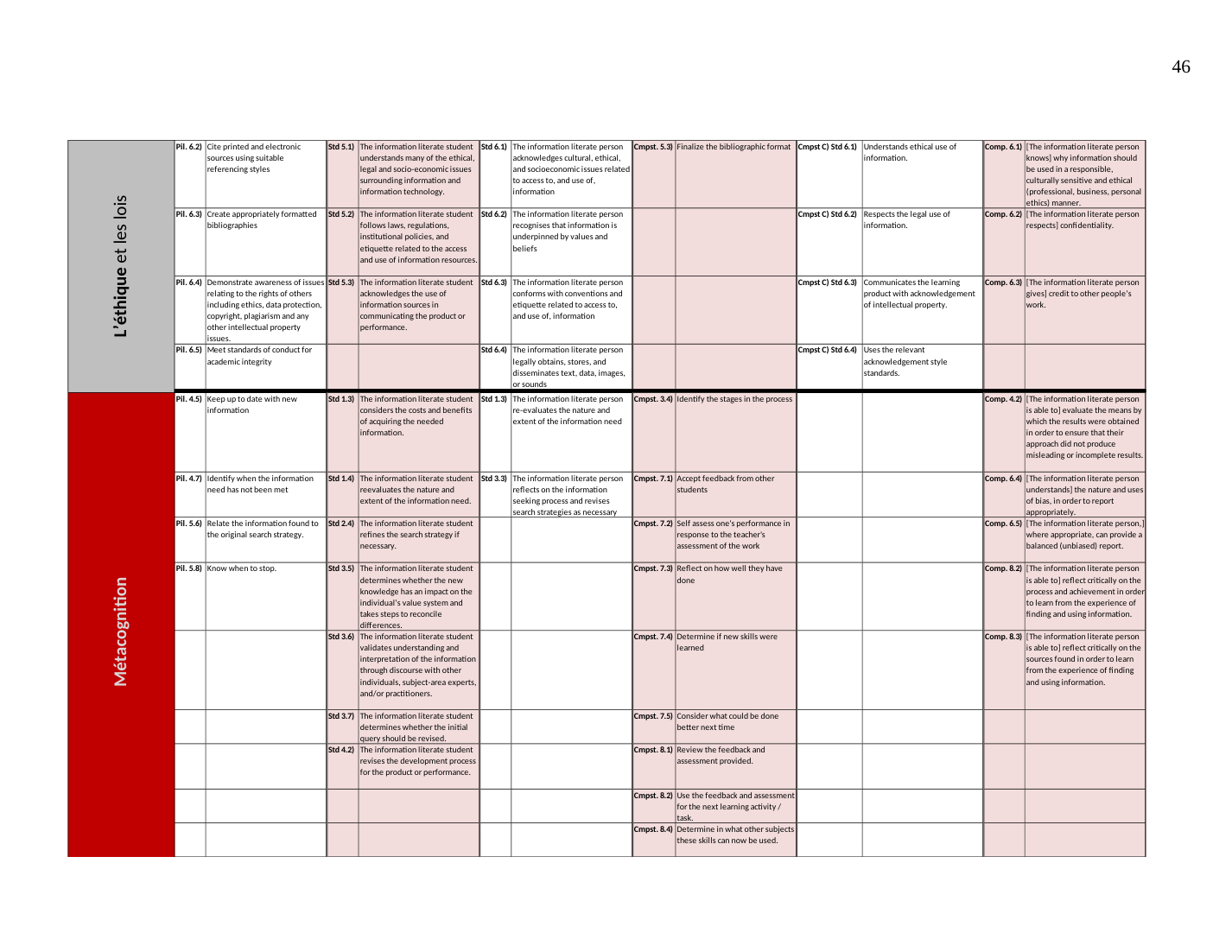
Reconstruction compacte du tableau d’analyse du mémoire. Les six modèles sources restent côte à côte; les 181 occurrences sont conservées dans leur langue d’origine et dans l’ordre vertical du tableau source. Les cases vides restent vides.Compact reconstruction of the manuscript analysis table. The six source models remain side by side; all 181 occurrences are preserved in their source language and source-table vertical order. Blank cells remain blank.
Établir un besoin d'informationEstablish an information need
SCONUL
ACRL
ANZIIL
NILIS
IFLA
CILIP
Pil. 1.1) Identify a lack of knowledge in a subject area
Std 1.1) The information literate student defines and articulates the need for information.
Std 1.1) The information literate person defines and articulates the information need.
Cmpst. 1.1) Define the topic/subject.
Cmpst A) Std 1.1) Defines or recognizes the need for information.
Comp. 1.1) [The information literate person is able to] recognise that information is needed.
Pil. 1.2) Identify a search topic / question and define it using simple terminology
Cmpst A) Std 1.2) Decides to do something to find the information.
Comp. 1.2) [The information literate person understands] why information is needed.
Pil. 1.3) Articulate current knowledge on a topic
Cmpst A) Std 1.3) Express and defines the information need.
Comp. 1.3) [The information literate person understands] what (and how much; what kind of ) information is required.
Pil. 1.4) Recognise a need for information and data to achieve a specific end and define limits to the information need
Comp. 1.6) [The information literate person is able to] articulate a question to develop a focus for research.
Pil. 1.5) Use background information to underpin the search
Pil. 1.6) Take personal responsibility for an information search
Pil. 2.1) Know what you don't know to identify any information gaps
Pil. 2.2) Identify which types of information will best meet the need
Pil. 3.1) Scope their search question clearly and in appropriate language
Trouver et accéder à l’informationFind and access information
SCONUL
ACRL
ANZIIL
NILIS
IFLA
CILIP
Pil. 1.7) Manage time effectively to complete a search
Std 1.2) The information literate student identifies a variety of types and formats of potential sources for information.
Std 1.2) The information literate person understands the purpose, scope and appropriateness of a variety of information sources.
Cmpst. 1.4) Identify the key words.
Cmpst A) Std 1.4) Initiates the search process.
Comp. 1.4) [The information literate person understands] constraints (e.g. time, format, currency, access).
Pil. 2.3) Identify the available search tools, such as general and subject specific resources at different levels
Std 2.1) The information literate student selects the most appropriate investigative methods or information retrieval systems for accessing the needed information.
Std 2.1) The information literate person selects the most appropriate methods or tools for finding information.
Cmpst. 1.5) Plan a search strategy.
Cmpst A) Std 2.2) Develops search strategies.
Comp. 1.5) [The information literate person understands] that information is available in a wide range of formats in various geographical and virtual locations.
Pil. 2.4) Identify different formats in which information may be provided
Std 2.2) The information literate student constructs and implements effectively designed search strategies.
Std 2.2) The information literate person constructs and implements effective search strategies.
Cmpst. 1.6) Identify different types of resources where information may be found.
Cmpst A) Std 2.3) Accesses the selected information sources.
Comp. 2.1) [The information literate person is able to] identify what resources are available for exploitation.
Pil. 2.5) Demonstrate the ability to use new tools as they become available
Std 2.3) The information literate student retrieves information online or in person using a variety of methods.
Std 2.3) The information literate person obtains information using appropriate methods.
Cmpst. 2.1) Locate resources appropriate to the chosen topic.
Cmpst A) Std 2.4) Selects and retrieves the located information.
Comp. 2.2) [The information literate person is able to] locate information resources.
Pil. 3.2) Define a search strategy by using appropriate keywords and concepts, defining and setting limits
Std 2.4) The information literate person keeps up to date with information sources, information technologies, information access tools and investigative methods.
Cmpst. 2.2) Find information appropriate to the chosen topic.
Comp. 2.3) [The information literate person is able to] access information ressources.
Pil. 3.3) Select the most appropriate search tools
Cmpst. 2.3) Do interviews, field trips or other outside research.
Comp. 2.5) [The information literate person is able to] determines when it is appropriate to use a specific information resource.
Pil. 3.4) Identify controlled vocabularies and taxonomies to aid in searching if appropriate
Comp. 3.1) [The information literate person is able to] search appropriate resources effectively.
Pil. 3.5) Identify appropriate search techniques to use as necessary
Pil. 3.6) Identify specialist search tools appropriate to each individual information need
Pil. 4.1) Use a range of retrieval tools and resources effectively
Pil. 4.2) Construct complex searches appropriate to different digital and print resources
Pil. 4.3) Access full text information, both print and digital, read and download online material and data
Pil. 4.4) Use appropriate techniques to collect new data
Pil. 4.5) Keep up to date with new information
Pil. 4.8) Use online and printed help and can find personal, expert help
Pil. 5.1) Distinguish between different information resources and the information they provide
Pil. 5.2) Choose suitable material on their search topic, using appropriate criteria.
Évaluer l’information de façon critiqueCritically evaluate information
SCONUL
ACRL
ANZIIL
NILIS
IFLA
CILIP
Pil. 5.3) Assess the quality, accuracy, relevance, bias, reputation and credibility of the information resources found.
Std 3.2) The information literate student articulates and applies initial criteria for evaluating both the information and its sources.
Std 1.4) The information literate person uses diverse sources of information to inform decisions.
Cmpst. 3.1) Choose relevant information.
Cmpst A) Std 2.1) Identifies and evaluates potential sources of information.
Comp. 2.4) [The information literate person is able to] evaluate the merits of individual information resource types.
Pil. 5.4) Assess the credibility of the data gathered.
Std 3.4) The information literate student compares new knowledge with prior knowledge to determine the value added, contradictions, or other unique characteristics of the information.
Std 3.1) The information literate person assesses the usefulness and relevance of the information obtained
Cmpst. 3.2) Determine which sources are too easy, too hard, or just right.
Cmpst B) Std 3.1) Analyzes, examines, and extracts information.
Comp. 3.2) [The information literate person is able to] identify relevant information.
Pil. 5.5) Read critically, identifying key points and arguments.
Std 3.2) The information literate person defines and applies criteria for evaluating information
Cmpst. 3.5) Collect appropriate citations.
Cmpst B) Std 3.2) Generalizes and interprets information.
Comp. 4.1) [The information literate person is able to] evaluate information for its authenticity, accuracy, currency, value and bias.
Pil. 5.7) Critically appraise and evaluate their own findings and those of others.
Cmpst. 4.2) Distinguish between fact, opinion, and fiction.
Cmpst B) Std 3.4) Evaluates accuracy and relevance of the retrieved information.
Pil. 7.2) Summarise documents and reports verbally and in writing
Cmpst. 4.3) Check for bias in the sources.
Cmpst B) Std 4.3) Determines which is the best and most useful information.
Organiser l’informationOrganize information
SCONUL
ACRL
ANZIIL
NILIS
IFLA
CILIP
Pil. 6.1) Use bibliographical software if appropriate to manage information
Std 2.5) The information literate student extracts, records, and manages the information and its sources.
Std 4.1) The information literate person records information and its sources.
Cmpst. 3.3) Record relevant information through note making or making a visual organizer such as a chart, graph, or outline, etc.
Cmpst B) Std 4.1) Arranges and categorizes information.
Comp. 8.1) [The information literate person is able to] to store and manage [acquired] information using the most effective methods available.
Pil. 6.6) Use appropriate data management software and techniques to manage data
Std 3.1) The information literate student summarizes the main ideas to be extracted from the information gathered.
Std 4.2) The information literate person organises (orders/classifies/stores) information.
Cmpst. 4.1) Sort the information.
Cmpst B) Std 4.2) Groups and organizes the retrieved information.
Pil. 7.2) Summarise documents and reports verbally and in writing
Cmpst. 4.4) Sequence the information in a logical order.
Cmpst. 4.5) Use visual organizers to compare or contrast information.
Cmpst. 8.5) Add product to a portfolio of productions.
Utiliser l'informationUse information
SCONUL
ACRL
ANZIIL
NILIS
IFLA
CILIP
Pil. 7.1) Use the information and data found to address the original question
Std 3.3) The information literate student synthesizes main ideas to construct new concepts.
Std 5.1) The information literate person compares and integrates new understandings with prior knowledge to determine the value added, contradictions, or other unique characteristics of the information.
Cmpst. 3.5) Collect appropriate citations.
Cmpst B) Std 3.1) Analyzes, examines, and extracts information.
Comp. 5.1) [The information literate person is able to] understand how to work with or exploit results.
Pil. 7.3) Incorporate new information into the context of existing knowledge
Std 4.1) The information literate student, individually or as a member of a group, uses information effectively to accomplish a specific purpose.
Cmpst. 5.1) Prepare information in their own words in a meaningful way.
Cmpst B) Std 3.2) Generalizes and interprets information.
Comp. 5.2) [The information literate person is able to] analyse and work with information to provide accurate, presentable research results.
Pil. 7.4) Analyse and present data appropriately
Cmpst. 8.3) Endeavour to use the knowledge gained in a variety of new situations.
Cmpst B) Std 3.3) Selects and synthesizes information.
Comp. 5.3) [The information literate person is able to] analyse and work with the information to provide to develop new knowledge and understanding.
Pil. 7.5) Synthesise and appraise new and complex information from different sources
Cmpst C) Std 5.2) Applies the retrieved information.
Cmpst C) Std 5.3) Learns or internalizes information as personal knowledge.
Communiquer l’informationCommunicate information
SCONUL
ACRL
ANZIIL
NILIS
IFLA
CILIP
Pil. 4.6) Engage with their community to share information
Std 4.3) The information literate student communicates the product or performance effectively to others.
Std 5.2) The information literate person communicates knowledge and new understandings effectively.
Cmpst. 1.2) Determine and understand the audience.
Cmpst C) Std 5.1) Finds new ways to communicate, present and use information.
Comp. 7.1) [The information literate person is able to] to communicate/share information in a manner or format that is appropriate to the information, the intended audience and situation.
Pil. 7.4) Analyse and present data appropriately
Cmpst. 1.3) Choose the relevant format for the finished product.
Cmpst C) Std 5.4) Presents the information product.
Cmpst. 5.2) Revise and edit, alone or with a peer.
Pil. 7.6) Communicate effectively using appropriate writing styles in a variety of formats
Cmpst. 6.1) Practice for presentation activity.
Pil. 7.7) Communicate effectively verbally
Cmpst. 6.2) Share the information with an appropriate audience.
Pil. 7.8) Select appropriate publications and dissemination outlets in which to publish if appropriate
Cmpst. 6.3) Display the information in an appropriate format to suit the audience.
Cmpst. 6.4) Set up and use equipment properly.
L’éthique, les responsabilités et les loisEthics, responsibilities and law
SCONUL
ACRL
ANZIIL
NILIS
IFLA
CILIP
Pil. 6.2) Cite printed and electronic sources using suitable referencing styles
Std 5.1) The information literate student understands many of the ethical, legal and socio-economic issues surrounding information and information technology.
Std 6.1) The information literate person acknowledges cultural, ethical, and socioeconomic issues related to access to, and use of, information
Cmpst. 5.3) Finalize the bibliographic format
Cmpst C) Std 6.1) Understands ethical use of information.
Comp. 6.1) [The information literate person knows] why information should be used in a responsible, culturally sensitive and ethical (professional, business, personal ethics) manner.
Std 5.2) The information literate student follows laws, regulations, institutional policies, and etiquette related to the access and use of information resources.
Std 6.2) The information literate person recognises that information is underpinned by values and beliefs
Cmpst C) Std 6.2) Respects the legal use of information.
Comp. 6.2) [The information literate person respects] confidentiality.
Pil. 6.4) Demonstrate awareness of issues relating to the rights of others including ethics, data protection, copyright, plagiarism and any other intellectual property issues.
Std 5.3) The information literate student acknowledges the use of information sources in communicating the product or performance.
Std 6.3) The information literate person conforms with conventions and etiquette related to access to, and use of, information
Cmpst C) Std 6.3) Communicates the learning product with acknowledgement of intellectual property.
Comp. 6.3) [The information literate person gives] credit to other people’s work.
Pil. 6.5) Meet standards of conduct for academic integrity
Std 6.4) The information literate person legally obtains, stores, and disseminates text, data, images, or sounds
Cmpst C) Std 6.4) Uses the relevant acknowledgement style standards.
MétacognitionMetacognition
SCONUL
ACRL
ANZIIL
NILIS
IFLA
CILIP
Pil. 4.5) Keep up to date with new information
Std 1.3) The information literate student considers the costs and benefits of acquiring the needed information.
Std 1.3) The information literate person re-evaluates the nature and extent of the information need
Cmpst. 3.4) Identify the stages in the process
Comp. 4.2) [The information literate person is able to] evaluate the means by which the results were obtained in order to ensure that their approach did not produce misleading or incomplete results.
Pil. 4.7) Identify when the information need has not been met
Std 1.4) The information literate student reevaluates the nature and extent of the information need.
Std 3.3) The information literate person reflects on the information seeking process and revises search strategies as necessary
Cmpst. 7.1) Accept feedback from other students
Comp. 6.4) [The information literate person understands] the nature and uses of bias, in order to report appropriately.
Pil. 5.6) Relate the information found to the original search strategy.
Std 2.4) The information literate student refines the search strategy if necessary.
Cmpst. 7.2) Self assess one's performance in response to the teacher's assessment of the work
Comp. 6.5) [The information literate person,] where appropriate, can provide a balanced (unbiased) report.
Pil. 5.8) Know when to stop.
Std 3.5) The information literate student determines whether the new knowledge has an impact on the individual’s value system and takes steps to reconcile differences.
Cmpst. 7.3) Reflect on how well they have done
Comp. 8.2) [The information literate person is able to] reflect critically on the process and achievement in order to learn from the experience of finding and using information.
Std 3.6) The information literate student validates understanding and interpretation of the information through discourse with other individuals, subject-area experts, and/or practitioners.
Cmpst. 7.4) Determine if new skills were learned
Comp. 8.3) [The information literate person is able to] reflect critically on the sources found in order to learn from the experience of finding and using information.
Std 3.7) The information literate student determines whether the initial query should be revised.
Cmpst. 7.5) Consider what could be done better next time
Std 4.2) The information literate student revises the development process for the product or performance.
Cmpst. 8.1) Review the feedback and assessment provided.
Cmpst. 8.2) Use the feedback and assessment for the next learning activity / task.
Cmpst. 8.4) Determine in what other subjects these skills can now be used.
Extraits des manuscrits
Manuscrit 4.0 · P029
word/document.xml; direct body paragraph 29
Original français
En parlant de la « société de l’information », on tend à se perdre dans les détails technologiques et dans les mécanismes de gestion de ces technologies. L’essence de la société de l’information n’est pas là. On oublie, dans notre histoire d’amour avec la technologie, que c’est l’information elle-même qui est la base de cette société émergente. La technologie n’est qu’un facteur du processus qui offre un accès à de l’information utile à des gens issus de classes sociales variées. Un moyen, pas une fin (p. 108, traduction libre).
Traduction éditoriale anglaise
When discussing the ‘information society,’ we tend to get lost in technological details and in the mechanisms used to manage those technologies. The essence of the information society is not there. In our love affair with technology, we forget that information itself is the basis of this emerging society. Technology is only one factor in a process that provides useful information access to people from different social classes. A means, not an end (p. 108, free translation).
Manuscrit 4.0 · P032
word/document.xml; direct body paragraph 32
Original français
En parlant de littératie traditionnelle, Pierre (2003) avance que : « le concept de littératie réfère à l'état des individus qui ont assimilé l'écrit dans leurs structures cognitives au point qu'il infiltre leurs processus de pensée et de communication et que l'ayant ainsi assimilé, ils ne puissent plus se définir sans lui » (p. 6). Ainsi, on pourrait dire que l'infolittératie, quant à elle, renvoie à l’état des individus qui ont assimilé la gestion de l’information « dans leurs structures cognitives au point [qu’elle] infiltre leurs processus de pensée et de communication et que l'ayant ainsi assimilé, ils ne puissent plus se définir sans [elle] ». Tout comme la littératie traditionnelle, l'infolittératie évoque quelque chose d’essentiel, soit l’état de l'individu ayant assimilé un ensemble complexe de compétences et de savoirs interconnectés, état qui dépasse largement la somme de ses parties.
Traduction éditoriale anglaise
In discussing traditional literacy, Pierre (2003) argues that ‘the concept of literacy refers to the state of individuals who have assimilated writing into their cognitive structures to the point that it permeates their thought and communication processes and, having assimilated it in this way, they can no longer define themselves without it’ (p. 6). We could therefore say that information literacy refers to the state of individuals who have assimilated information management ‘into their cognitive structures to the point that [it] permeates their thought and communication processes and, having assimilated it in this way, they can no longer define themselves without [it].’ Like traditional literacy, information literacy evokes something fundamental: the state of an individual who has assimilated a complex set of interconnected competencies and knowledge, a state that substantially exceeds the sum of its parts.
Manuscrit 4.0 · P033
word/document.xml; direct body paragraph 33
Original français
Plusieurs modèles d’infolittératie existent (Society of College National and University Libraries (SCONUL), 2011; American College and Research Libraries (ACRL), 2000; Australian and New Zealand Institute for Information Literacy (ANZIIL), 2004; Wijetunge et Alahakoon, 2005; Lau, 2006; Chartered Institute of Library and Information Professionals (CILIP), 2013; ACRL, 2015), mais la définition fonctionnelle du concept est généralement la même. Il s’agit de « l’ensemble des compétences dont les individus requièrent pour reconnaître lorsque l’information est nécessaire et pour être capable de trouver, d’évaluer et d’utiliser efficacement cette information » (ACRL, 2000, p. 2, traduction libre). En 2015, dans le nouveau modèle du ACRL qui se veut replacer le précédent, l’organisme propose une définition étendue de l’infolittératie, pour mettre l'emphase sur « le dynamisme, la flexibilité, la croissance personnelle et l'apprentissage communautaire » (ACRL, 2015, p. 8). Cette nouvelle définition est la suivante :
Traduction éditoriale anglaise
Several information-literacy models exist (Society of College National and University Libraries (SCONUL), 2011; American College and Research Libraries (ACRL), 2000; Australian and New Zealand Institute for Information Literacy (ANZIIL), 2004; Wijetunge and Alahakoon, 2005; Lau, 2006; Chartered Institute of Library and Information Professionals (CILIP), 2013; ACRL, 2015), but the functional definition of the concept is generally the same. It is ‘the set of abilities individuals require to recognize when information is needed and to be able to locate, evaluate, and use that information effectively’ (ACRL, 2000, p. 2, free translation). In 2015, in the new ACRL model intended to replace the previous one, the organization proposed an expanded definition of information literacy emphasizing ‘dynamism, flexibility, individual growth, and community learning’ (ACRL, 2015, p. 8). The new definition is as follows:
Manuscrit 4.0 · P034
word/document.xml; direct body paragraph 34
Original français
l'infolittératie c’est l'ensemble des compétences acquises qui englobent la découverte réflexive de l’information, la compréhension de comment l’information est produite et valorisée, et de l’usage de l’information pour créer des nouveaux savoirs et participer éthiquement aux communautés d’apprentissages (ACRL, 2015, p. 8, traduction libre).
Traduction éditoriale anglaise
Information literacy is the set of acquired abilities encompassing the reflective discovery of information, an understanding of how information is produced and valued, and the use of information to create new knowledge and participate ethically in communities of learning (ACRL, 2015, p. 8, free translation).
Manuscrit 4.0 · P035
word/document.xml; direct body paragraph 35
Original français
Ainsi, l’infolittératie renvoie en quelque sorte à la relation qu’entretiennent les individus avec l’information; relation qui, lorsque bien développée, permet aux individus infolettrés de s’épanouir par l’information.
Traduction éditoriale anglaise
Information literacy therefore refers, in a sense, to the relationship individuals maintain with information, a relationship that, when well developed, allows information-literate individuals to flourish through information.
Manuscrit 4.0 · P043
word/document.xml; direct body paragraph 43
Original français
La mésinformation est une information « fausse, erronée ou malavisée » (Fetzer, 2004, p. 231 ». Certains auteurs la définissent comme une information d’abord enregistré comme vrai, mais plus tard révélé comme fausse (Lewandowsky, Ecker, Seifert, Schwarz et Cook, 2012). Si la mésinformation est disséminé avec l’intention de tromper, il s’agit alors de désinformation (Cook, 2015). D’autres auteurs affirment que l’information est nécessairement vrai et que la mésinformation ou la désinformation ne peuvent donc pas être considéré comme de l’information (Dretske, 1983) : « l’information fausse, la mésinformation et […] la désinformation ne sont pas des variétés d’information, au même titre qu’un canard leurre n’est pas un canard » (p. 57). Pour notre recherche, nous définissons information au sens très large, c’est-à-dire : tout ensemble de données organisé de façon intelligible qui lui permet d'être communiqué et interprété à l'intérieur d'un contexte informationnel établi. Le contexte informationnel, c’est ce qui encadre l'information communiquée et qui lui permet d'être interprétée à l'intérieur d'un sens établi. Ainsi, nous pouvons accorder une valeur de crédibilité à l’information, c'est-à-dire une valeur qui représente selon qu’elle correspond à une réalité observable et réplicable à l'intérieur de son contexte informationnel, qui s'inscrit sur un continuum allant d‘ « très peu crédible » à « très crédible ». Sous cette définition, la mésinformation est une information soit a) ayant une valeur de vérité faible, mais communiquée comme ayant une valeur de vérité élevée ou, b) ayant une valeur de vérité élevée, mais communiquée comme ayant une valeur de vérité faible.
Traduction éditoriale anglaise
Misinformation is information that is ‘false, erroneous, or misleading’ (Fetzer, 2004, p. 231). Some authors define it as information initially recorded as true but later revealed as false (Lewandowsky, Ecker, Seifert, Schwarz, and Cook, 2012). When misinformation is disseminated with the intent to deceive, it becomes disinformation (Cook, 2015). Other authors argue that information is necessarily true and that misinformation or disinformation therefore cannot be considered information (Dretske, 1983): ‘false information, misinformation and […] disinformation are not varieties of information, any more than a decoy duck is a duck’ (p. 57). For our research, we define information very broadly as any set of data organized intelligibly so that it can be communicated and interpreted within an established information context. The information context is what frames communicated information and allows it to be interpreted within an established meaning. We can therefore assign information a credibility value, representing the degree to which it corresponds to an observable and replicable reality within its information context, on a continuum from ‘very low credibility’ to ‘very high credibility.’ Under this definition, misinformation is information that either (a) has low truth value but is communicated as having high truth value, or (b) has high truth value but is communicated as having low truth value.
Manuscrit 4.0 · P131
word/document.xml; direct body paragraph 131
Original français
Bien que les six modèles d'infolittératie présentés dans la section précédente s'emploient à décrire le même phénomène, les perspectives, structures et terminologies qui ont été privilégiées diffèrent. Nous avons donc fait une synthèse pour vérifier s'il existe une cohérence entre les modèles.
Traduction éditoriale anglaise
Although the six information-literacy models presented in the previous section seek to describe the same phenomenon, the perspectives, structures, and terminologies they privilege differ. We therefore produced a synthesis to determine whether coherence exists among the models.
Manuscrit 4.0 · P133
word/document.xml; direct body paragraph 133
Original français
Au niveau supérieur du modèle synthèse se trouvent les huit piliers de l'infolittératie, terminologie empruntée du modèle de SCONUL (2011). Les six premiers piliers ([1] établir un besoin d'information; [2] trouver et accéder à l’information; [3] évaluer l’information de façon critique; [4] organiser l’information; [5] utiliser l'information; [6] communiquer l’information) décrivent le processus de recherche d'information (PRI), mais ne doivent pas être interprétés de façon linéaire. Les piliers sont présentés dans un ordre logique de base. Or, il est important de reconnaître qu'à tout moment dans le processus, il est possible de naviguer d'un pilier à un autre. La non-linéarité des piliers de l'infolittératie fait aussi en sorte qu'il soit possible de les travailler de façon indépendante les unes des autres, bien qu'habituellement leur coexistence fait en sorte que l'appel à plusieurs piliers soit nécessaire pour répondre à une tâche informationnelle. C'est le septième pilier ([7] métacognition) qui permet de s'orienter dans le PRI. Finalement, le huitième pilier ([8] l’éthique et les lois) encadre l'entièreté du processus et assure l'intégrité de la recherche et de l'utilisation de l'information.
Traduction éditoriale anglaise
At the highest level of the synthesis model are the eight pillars of information literacy, terminology borrowed from the SCONUL model (2011). The first six pillars ([1] establish an information need; [2] find and access information; [3] critically evaluate information; [4] organize information; [5] use information; [6] communicate information) describe the information-research process (IRP), but must not be interpreted linearly. The pillars are presented in a basic logical order. It is nevertheless important to recognize that at any point in the process it is possible to move from one pillar to another. The nonlinearity of the information-literacy pillars also means that they can be developed independently, although their usual coexistence means that several pillars are often required to address an information task. The seventh pillar ([7] metacognition) makes it possible to orient oneself within the IRP. Finally, the eighth pillar ([8] ethics and laws) frames the entire process and ensures the integrity of information research and use.
Manuscrit 4.0 · P135
word/document.xml; direct body paragraph 135
Original français
Chaque pilier se décline ensuite en une, deux ou trois compétences qui sont détaillées par leurs composantes. Ces compétences proviennent d'une synthèse des compétences et de leurs composantes telles que présentées dans les autres modèles. Pour en arriver à cette synthèse, nous avons éliminé tout exemple ou référence à des technologies spécifiques, actions précises afin de rendre notre modèle le plus général possible.
Traduction éditoriale anglaise
Each pillar is then divided into one, two, or three competencies detailed through their components. These competencies come from a synthesis of the competencies and components presented in the other models. To produce this synthesis, we removed examples and references to specific technologies and precise actions in order to make our model as general as possible.
Manuscrit 4.0 · P136
word/document.xml; direct body paragraph 136
Original français
Par exemple, nous avons jugé que pour la composante « access full text information, both print and digital » (SCONUL, 2011), la mention « both print and digital » n'était pas nécessaire puisqu'elle imposait un cadre qui risquait d'être de ne plus être pertinent dans un avenir où une troisième option s'ajoutait. En reformulant à « accéder aux […] ressources d’information appropriées », nous arrivons à englober toutes les situations qui peuvent se présenter, sans limiter le sens de la composante.
Traduction éditoriale anglaise
For example, for the component ‘access full text information, both print and digital’ (SCONUL, 2011), we judged the phrase ‘both print and digital’ unnecessary because it imposed a frame that might no longer be relevant in a future where a third option existed. Reformulating it as ‘access appropriate […] information resources’ allows us to encompass the situations that may arise without limiting the meaning of the component.
Manuscrit 4.0 · P137
word/document.xml; direct body paragraph 137
Original français
Un autre exemple de généralisation est l'élimination des exemples critères d'évaluation de l'information. Bien que nous jugions ces exemples pertinents et utiles, nous préférons les mentionner en bas de page puisque la liste n'est pas exhaustive ou universellement applicable.
Traduction éditoriale anglaise
Another example of generalization is the removal of examples of information-evaluation criteria. Although we consider these examples relevant and useful, we prefer to mention them in a footnote because the list is neither exhaustive nor universally applicable.
Manuscrit 4.0 · P139
word/document.xml; direct body paragraph 139
Original français
Dans notre première tentative de classer les composantes des autres modèles, nous avons réalisé qu'un certain nombre de composantes provenant de compétences disparates ne s'inséraient pas de façon élégante dans les piliers que nous avions identifiés. Nous les avons donc isolés afin de vérifier s'il y avait un lien entre ces différents items. Ainsi, nous avons pu identifier le « Pillier 7 : Métacognition », à l'intérieur duquel se glissent aisément les composantes exclues de la synthèse initiale.
Traduction éditoriale anglaise
During our first attempt to classify components from the other models, we realized that a number of components from disparate competencies did not fit neatly into the pillars we had identified. We therefore isolated them to determine whether a relationship existed among these different items. This allowed us to identify ‘Pillar 7: Metacognition,’ within which the components excluded from the initial synthesis fit readily.
Manuscrit 4.0 · P140
word/document.xml; direct body paragraph 140
Original français
Le Pilier 7 se distingue des autres piliers puisqu'il décline les opérations métacognitives qui guident le PRI, plutôt qu'être axé sur des connaissances, des aptitudes ou des compétences. Il regroupe l'ensemble des opérations mentales où la personne prend conscience de son PRI et qui lui permet de raffiner son processus. Le Pilier 7 sous-tend chaque pilier, mais existe aussi à l'extérieur du PRI alors que la personne, ayant terminé sa recherche, réfléchit sur son expérience et détermine ce qui, à l'avenir, pourrait être amélioré afin de rendre son PRI plus efficace.
Traduction éditoriale anglaise
Pillar 7 differs from the other pillars because it describes the metacognitive operations that guide the IRP rather than focusing on knowledge, abilities, or competencies. It groups the mental operations through which a person becomes aware of their IRP and can refine the process. Pillar 7 underlies every pillar, but also exists outside the IRP when, after completing the research, the person reflects on the experience and determines what could be improved in the future to make the IRP more effective.
Manuscrit 5.1 · P038
word/document.xml; direct body paragraph 38
Original français
Selon certains, la mésinformation est une information accidentellement fausse ou trompeuse (European Parliamentary Research Service (EPRS), 2015) alors que d’autres la définissent comme une information initialement enregistrée comme vraie, mais plus tard révélé comme fausse (Lewandowsky, Ecker, Seifert, Schwarz et Cook, 2012), et d’autres encore argumentent que l’information est nécessairement vraie et que la mésinformation ne peut ipso facto être considérée comme de l’information : « l’information fausse, la mésinformation et […] la désinformation ne sont pas des variétés d’information, au même titre qu’un canard leurre n’est pas un canard » (Dretske, 1983, p. 57). Pour ce projet, entendons par "information" tout ensemble de données qui a été organisé, interprété, communiqué, réorganisé ou reproduit par un système de traitement d’information (STI) qui lui est adapté. Chaque être vivant, de la cellule à l’être humain, est à la base un STI, mais l’humain se distingue par son habileté à créer et utiliser des outils spécialisés et des STI artificielles, par exemple l’abacus ou l’ordinateur, qui servent à augmenter ses capacités de traitement de l’information et ainsi dépasser ses limites biologiques. Nous pouvons estimer la valeur de vérité d’une information en la situant sur un spectre qui va « d’absolument faux » à « absolument vrai ». Donc, a une valeur de vérité élevé une information qui retrouverait une structure constante, peu importe le nombre ou l’origine de STI indépendants qui traiteraient les données initiales. À l’inverse, a une valeur de vérité faible une information qui ne retrouverait pas une forme constante si des STI indépendents devaient traiter les mêmes données initiales. Avec cette définition, nous pouvons dire que la mésinformation est une information soit a) ayant une valeur de vérité faible mais traitée comme ayant une valeur de vérité élevée ou, b) ayant une valeur de vérité élevée mais traitée comme ayant une valeur de vérité faible. En d’autres mots, la mésinformation c’est simplement la conséquence d’une erreur humaine au niveau de l’évaluation, de la compréhension ou de la transmission d’une information.
Traduction éditoriale anglaise
According to some authors, misinformation is accidentally false or misleading information (European Parliamentary Research Service (EPRS), 2015), while others define it as information initially recorded as true but later revealed as false (Lewandowsky, Ecker, Seifert, Schwarz, and Cook, 2012), and still others argue that information is necessarily true and that misinformation therefore cannot ipso facto be considered information: ‘false information, misinformation and […] disinformation are not varieties of information, any more than a decoy duck is a duck’ (Dretske, 1983, p. 57). For this project, let ‘information’ mean any set of data that has been organized, interpreted, communicated, reorganized, or reproduced by an information-processing system (IPS) suited to it. Every living being, from the cell to the human being, is fundamentally an IPS, but humans are distinguished by their ability to create and use specialized tools and artificial IPSs, such as the abacus or computer, which increase their information-processing capacities and allow them to exceed biological limits. We can estimate the truth value of information by placing it on a spectrum from ‘absolutely false’ to ‘absolutely true.’ Information has a high truth value when it would retain a consistent structure regardless of the number or origin of independent IPSs processing the initial data. Conversely, information has a low truth value when it would not retain a consistent form when independent IPSs process the same initial data. Under this definition, misinformation is information that either (a) has low truth value but is processed as having high truth value, or (b) has high truth value but is processed as having low truth value. In other words, misinformation is simply the consequence of human error in the evaluation, understanding, or transmission of information.
Manuscrit 5.1 · P039
word/document.xml; direct body paragraph 39
Original français
Il n’y a pas si longtemps, le fardeau d’évaluer la qualité de l’information était généralement la tâche des experts de l’information (bibliothécaires, journalistes, chercheurs, scientifiques, etc.). Aujourd’hui, avec le Web 2.0, le fardeau a été presque du jour au lendemain transféré aux non-experts (Špiranec et Banek Zorica, 2010). Plus seulement qu’un simple consommateur passif d’information, chacun a maintenant le potentiel d’être un collaborateur actif qui contribue, pour le meilleur et pour le pire, au contenu et à la structure de l’univers de l’information. Alors bien que le phénomène de la mésinformation ne soit pas récent, « le problème a pris une nouvelle forme quand des millions de personnes ont acquis la capacité de publier sur Internet du matériel destiné à la consommation publique » (Levine, 2005, p. 1, traduction libre). Pour ces raisons, il n’est pas surprenant que la mésinformation soit un phénomène endémique à la société de l’information.
Traduction éditoriale anglaise
Not long ago, the burden of evaluating information quality generally belonged to information experts (librarians, journalists, researchers, scientists, etc.). With Web 2.0, that burden was transferred almost overnight to non-experts (Špiranec and Banek Zorica, 2010). No longer merely passive consumers of information, individuals now have the potential to become active collaborators who contribute, for better and for worse, to the content and structure of the information universe. Although misinformation is not a recent phenomenon, ‘the problem took on a new form when millions of people acquired the ability to publish material on the Internet for public consumption’ (Levine, 2005, p. 1, free translation). For these reasons, it is unsurprising that misinformation is endemic to the information society.
Manuscrit 5.1 · P043
word/document.xml; direct body paragraph 43
Original français
La désinformation, du russe dezinformatsia, c’est la manipulation intentionnelle et méthodique de l’information vraie et fausse dans le but d’exacerber les plus petites fissures d’un adversaire (Rid, 2017). Ce n’est pas qu’une simple erreur de transcription, comme la mésinformation : c’est une arme de la guerre de l’information, conçue pour polluer méthodiquement la sphère informationnelle d’un individu ou d’un groupe pour le forcer à agir contre ses intérêts et dans l’intérêt de l’instigateur. La désinformation peut être 99% vrai ou 100% fausse, puisqu’elle est définie par l’intention et non la valeur de vérité. Au-delà d’une ruse, la désinformation contemporaine permet d’atteindre des objectifs géopolitiques qui jusqu’à récemment étaient atteignables qu’avec des bombardements et des chars de combat. Arrimée aux médias sociaux et alternatifs, au Big Data et à l’intelligence artificielle et pointée vers le cerveau des masses sous la forme de propagande, la désinformation représente une des plus grandes menaces à la paix et à la stabilité en Occident (Facon, 2017).
Traduction éditoriale anglaise
Disinformation, from the Russian dezinformatsia, is the intentional and methodical manipulation of true and false information for the purpose of exacerbating the smallest fractures of an adversary (Rid, 2017). It is not merely a transcription error, like misinformation: it is a weapon of information warfare, designed to methodically pollute the information sphere of an individual or group in order to force them to act against their own interests and in the interests of the instigator. Disinformation can be 99% true or 100% false because it is defined by intent rather than truth value. Beyond simple deception, contemporary disinformation can achieve geopolitical objectives that, until recently, could only be achieved with bombing and battle tanks. Combined with social and alternative media, Big Data, and artificial intelligence, and directed at the minds of populations in the form of propaganda, disinformation represents one of the major threats to peace and stability in the West (Facon, 2017).
Manuscrit 5.1 · P144
word/document.xml; direct body paragraph 144
Original français
Bien que les six modèles d'infolittératie présentés dans la section précédente s'emploient à décrire le même phénomène, les perspectives, structures et terminologies qui ont été privilégiées diffèrent. Nous avons donc fait une synthèse pour vérifier s'il existe une cohérence entre les modèles.
Traduction éditoriale anglaise
Although the six information-literacy models presented in the previous section seek to describe the same phenomenon, the perspectives, structures, and terminologies they privilege differ. We therefore produced a synthesis to determine whether coherence exists among the models.
Manuscrit 5.1 · P146
word/document.xml; direct body paragraph 146
Original français
Au niveau supérieur du modèle synthèse se trouvent les huit piliers de l'infolittératie, terminologie empruntée du modèle de SCONUL (2011). Les six premiers piliers ([1] établir un besoin d'information; [2] trouver et accéder à l’information; [3] évaluer l’information de façon critique; [4] organiser l’information; [5] utiliser l'information; [6] communiquer l’information) décrivent le processus de recherche d'information (PRI), mais ne doivent pas être interprétés de façon linéaire. Les piliers sont présentés dans un ordre logique de base. Or, il est important de reconnaître qu'à tout moment dans le processus, il est possible de naviguer d'un pilier à un autre. La non-linéarité des piliers de l'infolittératie fait aussi en sorte qu'il soit possible de les travailler de façon indépendante les unes des autres, bien qu'habituellement leur coexistence impose que plusieurs piliers soient interpelés pour répondre à une tâche informationnelle. C'est le septième pilier ([7] métacognition) qui permet de s'orienter dans le PRI. Finalement, le huitième pilier ([8] l’éthique et les lois) encadre l'entièreté du processus et assure l'intégrité de la recherche et de l'utilisation de l'information.
Traduction éditoriale anglaise
At the highest level of the synthesis model are the eight pillars of information literacy, terminology borrowed from the SCONUL model (2011). The first six pillars ([1] establish an information need; [2] find and access information; [3] critically evaluate information; [4] organize information; [5] use information; [6] communicate information) describe the information-research process (IRP), but must not be interpreted linearly. The pillars are presented in a basic logical order. It is nevertheless important to recognize that at any point in the process it is possible to move from one pillar to another. The nonlinearity of the information-literacy pillars also means that they can be developed independently, although their usual coexistence means that several pillars are generally engaged to address an information task. The seventh pillar ([7] metacognition) makes it possible to orient oneself within the IRP. Finally, the eighth pillar ([8] ethics and laws) frames the entire process and ensures the integrity of information research and use.
Manuscrit 5.1 · P148
word/document.xml; direct body paragraph 148
Original français
Chaque pilier se décline ensuite en une, deux ou trois compétences qui sont détaillées par leurs composantes. Ces compétences proviennent d'une synthèse des compétences et de leurs composantes telles que présentées dans les autres modèles. Pour en arriver à cette synthèse, nous avons éliminé tout exemple ou référence à des technologies spécifiques, actions précises afin de rendre notre modèle le plus général possible.
Traduction éditoriale anglaise
Each pillar is then divided into one, two, or three competencies detailed through their components. These competencies come from a synthesis of the competencies and components presented in the other models. To produce this synthesis, we removed examples and references to specific technologies and precise actions in order to make our model as general as possible.
Manuscrit 5.1 · P149
word/document.xml; direct body paragraph 149
Original français
Par exemple, nous avons jugé que pour la composante « access full text information, both print and digital » (SCONUL, 2011), la mention « both print and digital » n'était pas nécessaire puisqu'elle imposait un cadre qui risquait d'être de ne plus être pertinent dans un avenir où une troisième option s'ajoutait. En reformulant à « accéder aux […] ressources d’information appropriées », nous arrivons à englober toutes les situations qui peuvent se présenter, sans limiter le sens de la composante.
Traduction éditoriale anglaise
For example, for the component ‘access full text information, both print and digital’ (SCONUL, 2011), we judged the phrase ‘both print and digital’ unnecessary because it imposed a frame that might no longer be relevant in a future where a third option existed. Reformulating it as ‘access appropriate […] information resources’ allows us to encompass the situations that may arise without limiting the meaning of the component.
Manuscrit 5.1 · P150
word/document.xml; direct body paragraph 150
Original français
Un autre exemple de généralisation est l'élimination des exemples critères d'évaluation de l'information. Bien que nous jugions ces exemples pertinents et utiles, nous préférons les mentionner en bas de page puisque la liste n'est pas exhaustive ou universellement applicable.
Traduction éditoriale anglaise
Another example of generalization is the removal of examples of information-evaluation criteria. Although we consider these examples relevant and useful, we prefer to mention them in a footnote because the list is neither exhaustive nor universally applicable.
Manuscrit 5.1 · P152
word/document.xml; direct body paragraph 152
Original français
Dans notre première tentative de classer les composantes des autres modèles, nous avons réalisé qu'un certain nombre de composantes provenant de compétences disparates ne s'inséraient pas de façon élégante dans les piliers que nous avions identifiés. Nous les avons donc isolés afin de vérifier s'il y avait un lien entre ces différents items. Ainsi, nous avons pu identifier le « Pillier 7 : Métacognition », à l'intérieur duquel se glissent aisément les composantes exclues de la synthèse initiale.
Traduction éditoriale anglaise
During our first attempt to classify components from the other models, we realized that a number of components from disparate competencies did not fit neatly into the pillars we had identified. We therefore isolated them to determine whether a relationship existed among these different items. This allowed us to identify ‘Pillar 7: Metacognition,’ within which the components excluded from the initial synthesis fit readily.
Manuscrit 5.1 · P153
word/document.xml; direct body paragraph 153
Original français
Le Pilier 7 se distingue des autres piliers puisqu'il décline les opérations métacognitives qui guident le PRI, plutôt qu'être axé sur des connaissances, des aptitudes ou des compétences. Il regroupe l'ensemble des opérations mentales où la personne prend conscience de son PRI et qui lui permet de raffiner son processus. Le Pilier 7 sous-tend chaque pilier, mais existe aussi à l'extérieur du PRI alors que la personne, ayant terminé sa recherche, réfléchit sur son expérience et détermine ce qui, à l'avenir, pourrait être amélioré afin de rendre son PRI plus efficace.
Traduction éditoriale anglaise
Pillar 7 differs from the other pillars because it describes the metacognitive operations that guide the IRP rather than focusing on knowledge, abilities, or competencies. It groups the mental operations through which a person becomes aware of their IRP and can refine the process. Pillar 7 underlies every pillar, but also exists outside the IRP when, after completing the research, the person reflects on the experience and determines what could be improved in the future to make the IRP more effective.
Annexes originales
Annexe 1 · Analyse des compétences
4.0 word/media/image1.emf; 5.1 word/media/image2.emf · 4.0 : page PDF 45
Les références originales aux six organismes sont les attributions des manuscrits : SCONUL (2011), ACRL (2000), ANZIIL (2004), NILIS / Wijetunge et Alahakoon (2005), IFLA / Lau (2006), CILIP (2013). Le présent graphe transcrit leurs occurrences dans les manuscrits ; il ne remplace pas ces versions par des textes plus récents.
La géométrie 3D et les traductions de navigation sont éditoriales, datées de 2026. Elles ne sont pas présentées comme des figures originales du mémoire. Les autres sections des deux manuscrits, notamment la problématique, les études de cas et le scrapbook, ne sont pas transcrites dans ce graphe consacré au modèle d’infolittératie.