HORTRAME: Accelerating Epistemological Alignment
Open multi-agent systems / priority consensus

Priority-State Dynamics in Open Multi-Agent Systems: Dynamic Membership and History-Dependent Consensus Endpoints

Exact conditions for restoring the mean priority after an agent joins, mixes and leaves — even when the initial rows disagree.

Research preprint

Current publication record. The interface is bilingual; the manuscript is in English. Article metadata and exact PDF identities are maintained once in the central research library.

The companion is a separate source-bound article. The central catalog records the current files, hashes and review status without duplicating the PDFs here.

Current article: G. Bolduc, “Priority-State Dynamics in Open Multi-Agent Systems: Dynamic Membership and History-Dependent Consensus Endpoints,” v07, HORTRAME Research, 2026.

When does a returning population recover its priority mean?

Adding or removing an agent changes both the owners of priority rows and the objective coordinates inside those rows. The paper characterizes the mean returned by a prescribed arrival–mixing–departure history, and exactly when a newcomer can restore the original mean. Incumbent agents need not agree before the transition.

CENTRAL RESULT · THEOREM 4.1

The returned mean is an explicit weighted combination

W→Jβ,v(W)→T Jβ,v(W)→U
m(U) = n∑r=1 θrwrT + θn+1qT

m averages the priority rows. W is the incumbent state; U is the state after the appended agent leaves. The coefficients θ are determined by the prescribed mixing and retained masses. The newcomer’s conditional priority on the original objectives is q.

Positive newcomer influence

q*T = bT / θn+1

For θn+1 > 0, this is the unique restoring conditional priority. It is admissible exactly when every component of b is strictly positive, where bT = m(W) − ∑r=1n θrwrT. W, β, γ and T are held fixed as q varies.

Zero newcomer influence

θn+1 = 0:   b = 0

Restoration holds exactly when b = 0, independently of q. Zero newcomer influence alone does not preserve the incumbent mean under arbitrary row-stochastic mixing.

Assumptions, coefficient definitions and exact error

Let n ≥ 1. W is a strictly positive n × n row-stochastic matrix. The incumbent insertion masses satisfy 0 < βi < 1. The newcomer row is vT = (γqT, 1 − γ), with 0 < γ < 1 and q a strictly positive probability vector. T is an (n+1) × (n+1) nonnegative row-stochastic matrix; it mixes the fixed expanded population before the appended agent alone departs.

a = (1 − β1, …, 1 − βn, γ)T
di = n+1∑r=1 Tirar
θr = (ar/n) n∑i=1 Tir/di

All di are positive, all θr are nonnegative and ∑r=1n+1 θr = 1. For positive newcomer influence, m(U) − m(W) = θn+1(q − q*)T. This theorem allows general row-stochastic T; it does not require symmetry, double stochasticity or a fixed consensus power. It is an offline input-level characterization, not a distributed arrival protocol for an unknown departure time.

Equal retention · Corollary 4.2

If T is also doubly stochastic and all incumbent insertion masses and the newcomer’s self mass equal β, let s = 1 − Tn+1,n+1. For s > 0:

q*T = (n∑j=1 Tn+1,jwjT) / s

This weighted average is always strictly positive and feasible. For s = 0, every admissible q restores the mean under these equal-retention and double-stochasticity assumptions. With one unweighted undirected Laplacian update and a non-isolated newcomer, q* is the mean of its neighbors’ pre-arrival rows. A longer stay generally requires a different q*; incumbent agreement is not required.

Why the event history matters: two exact examples

Returning labels do not restore the mean

The paper’s two-agent example starts with rows (9/10, 1/10) and (1/10, 9/10). Both incumbent insertion masses are 1/3; the newcomer row is (3/5, 1/10, 3/10). After one complete-graph update with c = 1/4 and proportional removal of the newcomer:

m(W) = (1/2, 1/2)  →  m(U) = (16/27, 11/27)

The same agents and labels return, with a different limiting priority under subsequent fixed-epoch average consensus.

A restoring priority depends on the stay

For incumbent rows (3/4, 1/4), (1/4, 3/4), equal insertion/self masses 1/3, and the path 1—2—3 with c = 1/4, q = (1/4, 3/4) restores (1/2, 1/2) after one update. Keeping that same q for two updates instead returns (31/64, 33/64). The two-update restoring choice is q* = (1/3, 2/3).

Arrival, departure and admissible state

Every row is a strictly positive probability vector over the active objectives. Arrival transforms incumbent row i into [(1 − βi)wiT, βi] and appends a chosen positive probability row vT. Departure selects surviving rows and objective columns, then divides each surviving row by its retained mass:

Q = SAWSAT,   DA(W) = diag(Q1)−1Q

The survivor set must be nonempty and each retained row mass positive. No pre-event consensus is needed. Removing an immediately appended agent with no intervening evolution recovers W exactly; mixing before departure can change that result. An empty population is outside this mathematical state space.

Background: agreement during a fixed epoch
W(k+1) = PW(k),   P = I − cL

For n ≥ 2, a fixed connected simple undirected graph and 0 < c < 1/dmax give standard synchronous average consensus. After the last event, that epoch’s row mean is the limiting priority. This supplies the endpoint interpretation of m(U) = m(W); it is not the new restoration theorem. For one agent, P = [1] and the gain test is omitted.

What the live restoration trial implements

Test endpoint restoration uses the equal-retention corollary with T = Pℓ. It computes q* for the actual expanded graph and prescribed stay, adds that newcomer, performs exactly ℓ committed updates, then removes it. The returned mean is compared with the saved initial mean; export retains the matrices, graph, gain, mixing row, q and measured error.

Ordinary manual arrivals sample a positive newcomer row and need not restore an earlier endpoint. Unplanned membership, priority or graph/gain changes interrupt the controlled trial. The controls do not expose every arbitrary T and unequal-retention input admitted by the general theorem.

Synthetic message delays

The switch at the top of the controls enables uniform or independently varied nonnegative link delays. Moving dots represent messages; amber rings mark robots still waiting and green rings mark readiness. Each required directed link carries its row from the same frozen old state. A loss-free central barrier waits for all deliveries before committing the synchronous update. The simulation clock sets the delay duration; pause freezes it. State or topology changes invalidate obsolete rounds.

This transport changes elapsed time, not the prescribed sequence of logical mixing steps. It does not implement Naderi’s asynchronous delayed-state correction or prove a combined delayed/open-membership protocol.

Motion, agreement and physical evidence

The robot controller uses the epoch mean applied to the active agents’ fixed spawn positions, separately from the evolving local priority rows. It plans feasible gathering places around obstacles. The animation illustrates motion; the paper claims no new physical-rendezvous or optimization-convergence theorem.

Priority agreement is a numerical tolerance on ‖W − 1m(W)‖F. Celebration also requires settled, connected, collision-free gathering; blocked routes can prevent it. Removing the last robot makes the interface inactive; the next arrival starts a new system. The current membership formulas and browser implementation have not been tested on physical robots.

Conditional application to communication loss

Admissible membership maps and finite-event continuation can give state-transition semantics to a policy that treats sustained communication loss as deliberate departure and later reconnection as a defined arrival, without requiring prior priority consensus. Re-entry needs a declared state and coherent objective labels.

Fault detection, agreement on membership, connectivity after removal, state transfer and continuing failures require separate mechanisms and arguments. Restoration still depends on the stated conditions. The browser implements neither a loss detector nor this fault-management policy.

Simulation

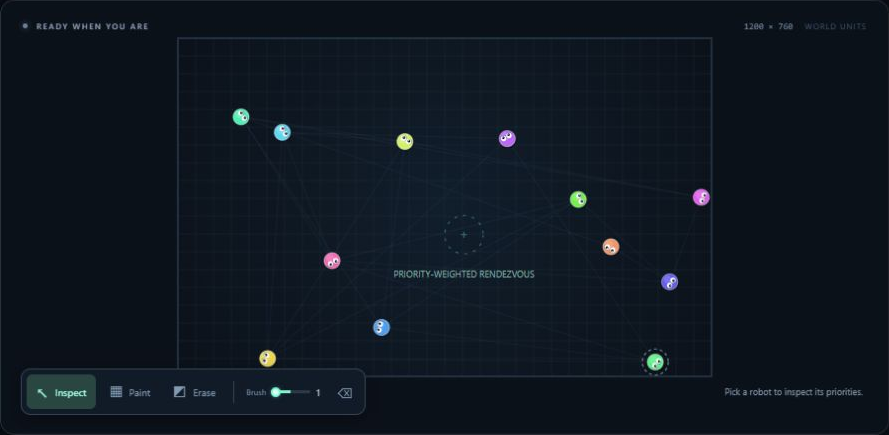
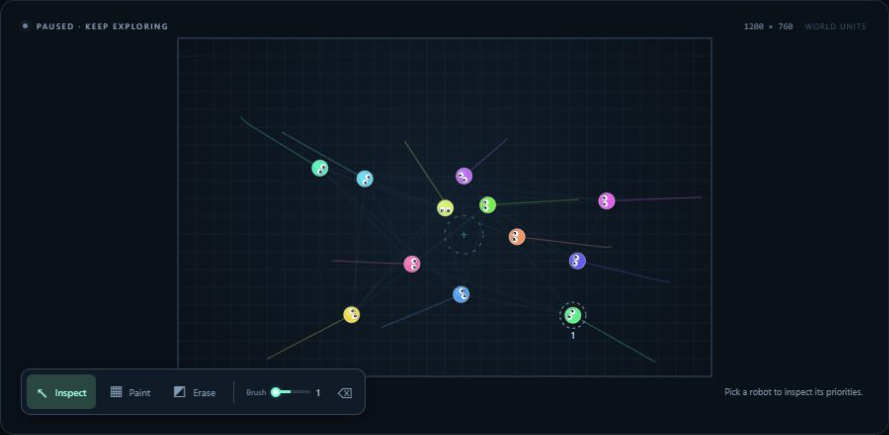
The full manuscript retains these three original captures from one browser run. They illustrate the motion controller; they are not measurements of communication delays or a new physical experiment.

Scattered robots at the start of the simulation
01 / BeginningInitial population before motion.
Robots gathering during the simulation
02 / MotionTrails and gathering in progress.
Celebration following numerical agreement and gathering
03 / Agreement and gatheringCelebration under the numerical and motion criteria.
Open interactive simulation ↗

Position in the literature

The contribution is the prescribed-history endpoint characterization for active-objective probability rows. Fixed-membership priority variation and delays are studied by Naderi and Blondin and Naderi, Blondin and Roy. Open-system dimension changes and state maps already occur in Zhou et al. and Deplano et al.; mass/count accounting under dynamic communication and delay assumptions appears in Hu et al.. The manuscript compares their state semantics and mechanisms, rather than claiming that open membership or changing dimension is new.

Equal final priorities can have an optimization interpretation under the paper’s assumptions; the result does not establish convergence of a decision-update algorithm. The full references and supporting arguments are in the English PDFs.

AI-use disclosure

This work was developed with assistance from AI agents operating within the HORTRAME Systems research architecture. Depending on the research stage, these agents contributed to literature analysis, mathematical formulation, proof reconstruction, adversarial review, counterexample search, simulation and code analysis, verification design, reproducibility checks, revision, and manuscript preparation. AI-agent outputs were treated as research artifacts subject to verification and correction rather than as independent authority. G. Bolduc is the human author responsible for the manuscript, its claims, source selection, and publication decisions. AI-agent review does not constitute independent human peer review, proof-assistant certification, experimental validation, or publication acceptance.

Article v07 · Interface v07 · Process v07 · Release record